

Losing a single tooth can feel minor compared to full mouth tooth loss, but it still changes how you chew, smile, and protect the teeth around the gap. At JP Prosthodontics in Fullerton, CA, many patients ask one key question when replacing a single missing tooth: “Should I get a dental implant or a bridge?”
Both options can restore your smile, but they work very differently and have different long-term consequences. This guide lays out the facts so you can understand the trade-offs and choose a solution that fits your mouth, timeline, and long-term goals.
What a Single-Tooth Dental Implant Is
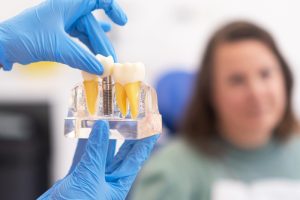
A single-tooth dental implant replaces the entire missing tooth structure from root to crown. It has three parts:
- Titanium implant: The small post placed into the jawbone where the tooth root used to be
- Abutment: The connector piece that sits on top of the implant
- Crown: The visible tooth-shaped restoration attached to the abutment
Key features of single-tooth implants:
- Standalone solution: The implant and crown do not depend on neighboring teeth for support.
- Root replacement: The implant acts like an artificial root and integrates with the bone.
- Bone support: Chewing on the implant stimulates the jawbone and helps slow bone loss.
- Natural appearance: A custom crown is designed to match the color and shape of your surrounding teeth.
At JP Prosthodontics, the implant and crown are planned together from the start. The dental implants page explains how careful planning, 3D imaging, and prosthodontic training help position the implant where it needs to be for proper function and aesthetics.
What a Traditional Dental Bridge Is
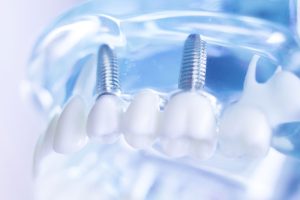
A traditional dental bridge replaces a missing tooth by using the teeth on either side of the gap as supports.
How a bridge works:
- The teeth on both sides of the gap are prepared (shaved down) for crowns.
- A custom restoration is made with two crowns and a “pontic” (the false tooth) fused between them.
- The bridge is cemented onto the prepared teeth, spanning across the missing space.
Key features of traditional bridges:
- Fixed solution: A bridge is cemented in place and does not come in and out.
- Faster timeline: No surgical healing is required, so treatment can often be completed faster than implants.
- Relies on neighboring teeth: The success of the bridge depends on the health and strength of the teeth next to the gap.
For patients considering bridges for cosmetic or restorative reasons, JP Prosthodontics also offers advanced materials and design for dental crowns and bridges, so the final work blends naturally with the rest of the smile.
Comparing Implants and Bridges: Tooth Preservation
Single-tooth dental implants:
- Do not require altering the neighboring teeth.
- Protect adjacent teeth from being shaved down for crowns.
- Reduce the risk of future problems with those neighboring teeth.
Traditional bridges:
- Require removal of healthy tooth structure from neighboring teeth to make room for crowns.
- Can create future issues if the supporting teeth develop decay, cracks, or nerve problems.
- If one supporting tooth fails, the entire bridge usually needs to be replaced.
If the teeth next to the gap are healthy and intact, a single-tooth implant is usually the more conservative, tooth-preserving choice. If neighboring teeth already need crowns, a bridge may be considered as part of a more comprehensive plan.
Bone Health and Long-Term Facial Support
Implants:
- Transfer chewing forces into the jawbone, similar to a natural tooth root.
- Help maintain bone height and thickness around the missing tooth site.
- Support long-term stability of the bite and local facial structure.
Bridges:
- Sit above the gums and do not stimulate the bone in the missing tooth area.
- Allow bone in the gap to slowly resorb over time.
- Can lead to a slight indentation or collapse in the ridge where the tooth used to be.
In a practice focused on implant and restorative dentistry like JP Prosthodontics, maintaining bone and structure is a central goal. For cases involving more extensive reconstruction, options like zirconia fixed bridges provide additional solutions, but the principle is the same: a stable foundation leads to more predictable results.
Chewing Function and Daily Comfort
Both implants and bridges restore the ability to chew in the area of the missing tooth, but there are differences in how they handle forces over time.
Implants:
- Anchor directly into bone for strong, stable support.
- Allow chewing forces to be handled by the implant rather than stressing neighboring teeth.
- Can feel very similar to a natural tooth once integrated and restored.
Bridges:
- Transfer biting forces onto the supporting teeth at each end of the bridge.
- Increase the workload on those teeth.
- Can perform well for many years but are more sensitive to problems in the supporting teeth.
When a prosthodontist like Dr. Joon Park designs a single implant crown or a bridge, he is looking at your entire bite, not just one space. That includes how your upper and lower teeth meet, how you chew, and whether there are areas of excessive force that could shorten the life of the restoration.
Longevity and Maintenance
Implants:
- Titanium implants can last decades or even a lifetime with proper care.
- The crown on top may eventually be replaced due to normal wear or cosmetic updates.
- Standard home care includes brushing, flossing, and regular professional cleanings.
- Maintenance visits focus on gum health, bone levels, and integrity of the implant–crown connection.
Bridges:
- Average lifespan is often in the 10–15 year range, though this varies based on hygiene, bite, and materials.
- If decay or damage affects a supporting tooth, the entire bridge often needs replacement.
- Cleaning under the pontic (false tooth) is essential to prevent plaque buildup.
- Requires floss threaders or special tools to clean under the bridge.
Cost Considerations
Implants:
- Higher upfront cost for surgery and custom implant components.
- Often provide better long-term value because they preserve bone and do not sacrifice neighboring teeth.
- May reduce the need for future dentistry on adjacent teeth.
Bridges:
- Lower initial cost in many cases.
- Can become more expensive over time if supporting teeth need root canals, retreatment, or additional crowns.
- Replacement bridges are sometimes needed as teeth change or fail.
A proper cost discussion looks beyond the first year and considers what is likely over 10–20 years. JP Prosthodontics covers these timelines and potential scenarios in detail during planning so there are fewer surprises later.
When a Single-Tooth Implant Is Usually Preferred
A single-tooth dental implant is often recommended when:
- The teeth next to the gap are healthy and do not need crowns.
- You want to preserve natural tooth structure wherever possible.
- Maintaining bone height and long-term stability is a priority.
- You are medically suitable for implant surgery.
- You value a solution that functions and feels close to a natural tooth.
When a Dental Bridge May Be Appropriate
A traditional bridge may be considered when:
- The adjacent teeth already need crowns for cracks, large fillings, or cosmetic reasons.
- Medical or anatomical issues limit the use of implants at that specific site.
- You prefer to avoid surgery or have time constraints that favor a quicker solution.
- The site has limited bone and grafting is not desired.
The Prosthodontic Approach at JP Prosthodontics
The advantage of working with a prosthodontist is that you are not locked into a single method. Dr. Joon W. Park, DMD, is trained to plan both implant and tooth-borne solutions and recommend what best fits your mouth, not a one-size-fits-all protocol. You can learn more about his background and treatment philosophy on the Dr. Joon W. Park profile.
Evaluation at JP Prosthodontics typically includes:
- Comprehensive exam and digital imaging of the area
- Bite and occlusion analysis
- Assessment of bone volume and gum health
- Review of your medical history and healing capacity
- Discussion of your goals for aesthetics, function, and long-term maintenance
From there, the plan might involve a single implant, a bridge, or part of a broader reconstruction depending on what else is happening with your teeth and bite.
Next Step
Replacing a single missing tooth is not a small decision. The choice between an implant and a bridge affects the health of neighboring teeth, the bone under the gap, and the long-term stability of your bite.
For a precise evaluation and a treatment plan built around your specific needs in Fullerton, CA, use the contact page to schedule a visit with JP Prosthodontics.