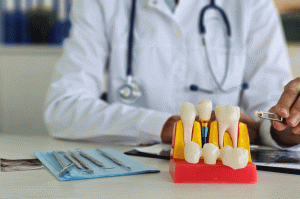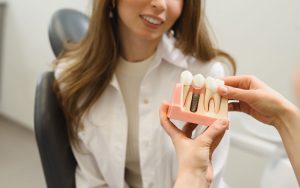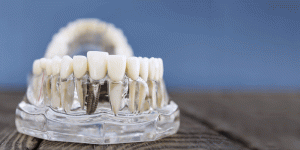


Dental implants are one of the most predictable ways to replace missing teeth—but not every patient starts as an ideal candidate. At JP Prosthodontics in Fullerton, CA, candidacy is determined through structured evaluation, not assumptions.
This guide outlines the exact factors used to determine whether dental implants are appropriate, what can disqualify a patient temporarily, and what can be corrected to make treatment possible.
The Baseline Requirement: Enough Bone Support
Dental implants require sufficient jawbone to anchor securely. Without it, the implant cannot integrate properly.
You are likely a candidate if:
- You have adequate bone height and width
- Tooth loss is recent or bone loss is minimal
- You have not worn loose dentures for many years
You may still qualify with additional steps if:
- Bone has shrunk after long-term tooth loss
- The ridge is thin or uneven
- Sinus expansion has reduced upper jaw bone height
In these cases, bone grafting can rebuild the foundation before implant placement. The approach is explained in detail on the dental implants page.
Gum Health: A Non-Negotiable Factor
Healthy gums are required to support implants long-term.
You are a stronger candidate if:
- Gums are firm, pink, and free of bleeding
- There is no active periodontal (gum) disease
- You maintain consistent oral hygiene
You are not ready yet if:
- There is active gum infection
- You experience bleeding, swelling, or deep pockets
- Past periodontal disease is uncontrolled
Gum disease must be treated and stabilized before implant placement. Otherwise, the same infection can affect the implant and lead to failure.
Overall Health and Healing Ability
Implants rely on your body’s ability to heal and integrate with the implant surface.
Good candidates typically:
- Have controlled medical conditions
- Maintain stable blood sugar levels (if diabetic)
- Are not undergoing aggressive medical therapies that affect healing
Factors that may delay or complicate treatment:
- Uncontrolled diabetes
- Immune disorders
- Certain medications that affect bone metabolism
- Ongoing cancer treatments
These do not always rule out implants but require coordination with your physician and careful planning.
Smoking and Its Impact on Implant Success
Smoking significantly reduces blood flow and healing capacity in the gums and bone.
Impact of smoking:
- Slower healing after surgery
- Higher risk of infection
- Increased chance of implant failure over time
Patients who smoke are not automatically excluded, but outcomes improve when smoking is reduced or stopped, especially during the healing phase.
Bite Forces and Grinding (Bruxism)
Excessive force can overload implants and reduce their lifespan.
You may need additional protection if you:
- Grind or clench your teeth at night
- Have a history of cracked teeth or worn enamel
- Experience jaw tension or TMJ symptoms
In these cases, a nightguard is often recommended to protect both implants and natural teeth. Bite analysis is part of every implant plan at JP Prosthodontics.
Number of Missing Teeth Matters
Candidacy also depends on how many teeth are missing and how they are distributed.
Single missing tooth:
- Often the simplest implant case
- Requires localized bone and gum health
Multiple missing teeth:
- May require strategic implant placement
- Could involve bridges or staged treatment
Full arch tooth loss:
- Requires comprehensive planning
- May involve solutions like full mouth dental implants
- Often includes evaluation of bone distribution and bite balance
Each scenario has different requirements, timelines, and complexity levels.
Age: What Actually Matters
Age alone does not determine candidacy.
You are generally a candidate if:
- Jaw growth is complete (typically late teens or older)
- You are healthy enough for minor oral surgery
Older adults frequently qualify for implants and benefit from improved stability compared to dentures. The key factor is health and bone condition—not age.
Commitment to Maintenance
Dental implants require long-term care. Patients who neglect maintenance increase their risk of complications.
You are a strong candidate if you:
- Brush and clean around teeth daily
- Attend regular dental visits
- Follow post-treatment instructions
Implants are not “maintenance-free.” They require consistent care to remain stable and healthy.
When You Are Not a Candidate Yet
Some patients are not immediate candidates but can become eligible with the right preparation.
Common situations:
- Active gum disease → treat infection first
- Insufficient bone → perform bone grafting
- Poor oral hygiene → improve home care routine
- Medical instability → stabilize condition with physician
These are delays, not permanent exclusions. A structured treatment plan addresses each barrier step by step.
The Evaluation Process at JP Prosthodontics
Candidacy is determined through a comprehensive assessment, not a quick visual exam.
The process includes:
- Clinical exam of teeth, gums, and bite
- 3D imaging (CBCT) to measure bone volume
- Evaluation of bite forces and jaw function
- Review of medical history and medications
- Discussion of goals, expectations, and budget
Dr. Joon W. Park, DMD uses prosthodontic training to align implant placement with the final restoration, ensuring that function and aesthetics are planned together. Learn more on the Dr. Joon W. Park profile.
Clear Candidate Checklist
You are likely a good candidate for dental implants if:
- You have sufficient bone or are open to grafting
- Your gums are healthy or can be treated
- Your medical conditions are controlled
- You are willing to maintain proper oral hygiene
- You understand the treatment timeline and follow-up care
You may need preparation first if:
- Bone loss is severe
- Gum disease is active
- Health conditions are unstable
- Oral hygiene is inconsistent
Summary
Dental implant candidacy is not a yes-or-no label. It is a process. Most patients either qualify immediately or can become candidates with the right preparation.
Bone, gum health, medical status, bite forces, and long-term maintenance all determine success. Each factor is evaluated and addressed before treatment begins.
At JP Prosthodontics in Fullerton, CA, implant planning focuses on predictable, long-term outcomes—not shortcuts.
For a precise evaluation and a step-by-step plan, schedule a consultation through the contact page.